Psychological fidelity: A systematic review to support simulation-based training
Andrea C. Silva and Olivia B. Newton
University of Central Florida
Abstract:
The objective of this research is to advance the understanding and achievement of psychological fidelity in simulation for training and research. Psychological fidelity refers to the degree that the simulation reproduces contextual elements associated with affective and cognitive processes manifested and in line with the corresponding real-world environment. We contend that psychological fidelity is critical for the efficacy of training with simulators for complex tasks and environments but remains understudied in simulation. As such, there is a need to grow research on psychological fidelity in simulation. Through a systematic literature review, we integrate existing work on psychological fidelity in simulation to identify common approaches and reconcile differences across disciplines and domains. From this, we produce a parsimonious understanding of psychological fidelity which enables the systematic evaluation and implementation of simulation training. To facilitate future research, we offer a set of research questions based on gaps and opportunities in the literature.
Objective
The objective of this research is to advance the understanding and achievement of psychological fidelity in simulation for training and research. Psychological fidelity refers to the degree that psychological elements in simulation are manifested and represented in line with the corresponding real-world context (Kaiser & Schroeder, 2002; Liu et al., 2008). Although the notion of psychological fidelity in simulation-based training was introduced in the literature nearly three decades ago (e.g., Patrick et al., 1996), the concept remains understudied and underutilized in the development and evaluation of simulation (Kuipers et al., 2019). We contend that psychological fidelity is critical for the efficacy of training with simulators for complex tasks and environments. As such, there is a need to grow research on psychological fidelity in simulation. To provide a foundation for empirical work on this topic, we conduct a survey of the literature to answer the following questions:
How has psychological fidelity in simulation been conceptualized to date?
How is psychological fidelity linked to individual, group, organizational, and task factors in simulation-based training?
Through a systematic literature review, we integrate existing theoretical and empirical work on psychological fidelity in simulation to identify common approaches and reconcile differences across disciplines and domains. From this, we expect to produce a parsimonious understanding of psychological fidelity which will enable the systematic evaluation and implementation of simulation training systems. To facilitate future research on psychological fidelity, we offer a set of research questions based on gaps and opportunities in the literature, including, for example:
Which aspects of psychological fidelity are essential for independent tasks versus collaborative tasks?
Which aspects of psychological fidelity are essential for contexts with time pressure versus those without?
Which aspects of psychological fidelity are essential for familiar events versus unfamiliar events?
What types of task features can be leveraged to achieve psychological fidelity?
What types of environmental features can be leveraged to achieve psychological fidelity?
Approach
Through our work, we produce a theoretical foundation for research on psychological fidelity. As a first step, we employ a systematic literature review to identify all relevant works on psychological fidelity and evaluate the forms in which the concept has been applied and assessed in simulation-based training. In line with guidance from Crocetti (2016) and Cronin et al. (2008), we define our research question in addition to inclusion and exclusion criteria. We then apply a keyword search to three databases—PsychINFO, Web of Science, and Medline—to ensure broad coverage of publication venues. The titles and abstracts of publications identified in the search are then screened before proceeding to full review for eligibility in the final sample for systematic review. The final set of studies are analyzed and synthesized using the Input Mediator Output Input model (Ilgen et al., 2005).
As a second step, we propose a conceptualization of psychological fidelity which can be used by researchers and practitioners alike to improve simulation-based training. The multidimensional view of psychological fidelity presented within this work reflects the varied psychological and cognitive phenomena that are present in the organizational and operational contexts for which trainings are developed (e.g., aerospace, medical). Furthermore, we identify a set of task factors and environmental features that can be leveraged to study and design training with psychological fidelity. Related, to inform future research on psychological fidelity, we present a set of research questions to redress gaps in the literature.
Findings
Through our systematic literature review, we find that the study of psychological fidelity in simulation-based training has been limited to date, in terms of both general research and the specific contexts in which it has been applied. First, we observe that few works have engaged with this type of fidelity in simulation at all or beyond cursory or shallow engagement in comparison to other types (e.g., physical fidelity). Second, we document a bibliometric and scientometric analysis of the literature to characterize trends in simulation-based training and research that account for psychological fidelity. Third, we identify psychological fidelity as a key path for increasing the ecological validity of training systems that integrate simulation methods to support knowledge acquisition and procedural rehearsal. Through our comprehensive examination of this topic, we (1) synthesize findings demonstrating the importance of psychological fidelity for training efficacy and (2) outline significant gaps in the study of psychological fidelity in simulation. The findings of the present effort highlight a need in the development of simulation-based training that human factors is uniquely well-equipped to address. We expect that our findings will create opportunities for enhancing the utility of simulation and simulators for research and practice.
Takeaways
Simulation-based training provides important experience with and exposure to procedures and scenarios used in complex work contexts found in domains like aerospace and medicine. To be effective, such training approaches necessitate simulation fidelity, that is, a certain degree of realism. We argue that greater research is needed to better understand and produce a critical dimension of simulation fidelity: psychological fidelity. The results of a systematic literature review reveal that psychological fidelity is both understudied and inconsistently applied in research and training with simulation. To support future research, we integrate the varied conceptualizations and operationalizations of psychological fidelity found across disciplines to produce a unified perspective. We additionally offer a set of research questions for the systematic implementation and evaluation of psychological fidelity in simulation-based training. We expect that this work can contribute to greater ecological validity in research with simulation, as well as a greater understanding of the factors that influence, and are influenced by, psychological fidelity. From a theoretical standpoint, this research helps us understand how psychological fidelity influences learning outcomes and skill acquisition. From a practical standpoint, this research can inform the design and development of effective simulation-based training.
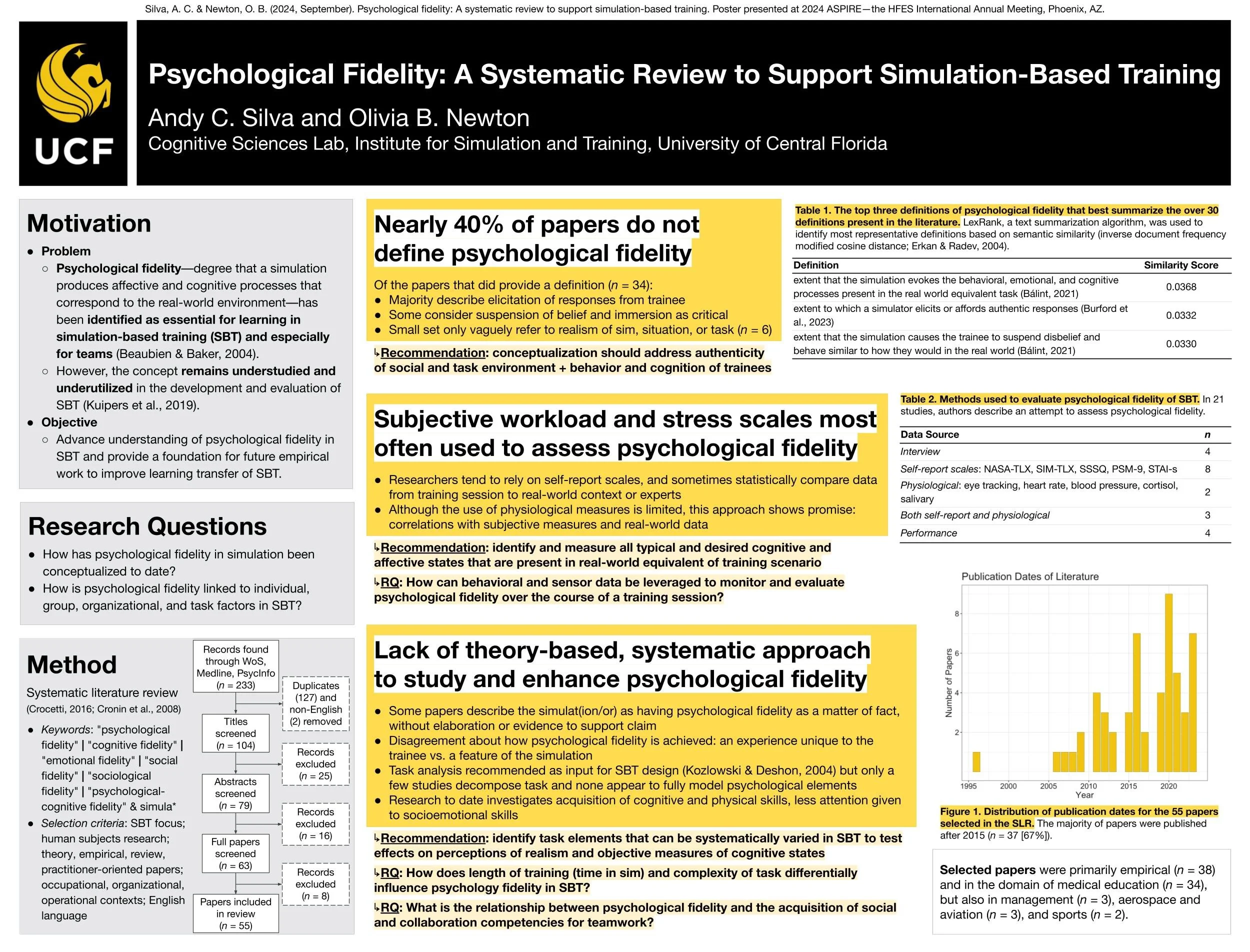
Silva, A. C. & Newton, O. B. (2024, September). Psychological fidelity: A systematic review to support simulation-based training. Poster presented at 2024 ASPIRE—the HFES International Annual Meeting, Phoenix, AZ.
