Building Together: How Social Robots Support Collaborative Problem Solving in Children
Andrea C. Silva1,2; Sharifa Alghowinem3; Sarah Gillet3; Stephen Fiore4; Cynthia Breazeal3
1Department of Statistics, University of Central Florida, Orlando, FL
2Department of Psychology, University of Central Florida, Orlando, FL
3Department of Media Arts and Sciences, Massachusetts Institute of Technology, Cambridge, MA
4Department of Philosophy, University of Central Florida, Orlando, FL
Abstract
Collaborative problem-solving (CPS) is a critical skill for children’s academic and social development. However, many children lack proficiency in these competencies and require targeted intervention to develop them. Social robots offer a promising approach: they can deliver theory-based interventions with high consistency across implementations, making scalable support for collaboration development feasible in educational settings. This between-subjects study investigates whether proactive collaborative scaffolding from a social robot (Jibo) improves children’s CPS skills compared to proactive non-collaborative support. Participants are 5th-grade children (ages 10-11) working in dyads on two Lego-based problem-solving tasks: an analytical task (building a maze) and a creative task (designing a park). Children are randomly assigned to one of two conditions: (1) Collaborative condition, in which Jibo provides utterances grounded in the PISA 2015 CPS Framework to scaffold collaboration, or (2) Non-Collaborative condition, a control condition in which Jibo responds to the same behavioral triggers with non-collaborative utterances. Collaboration is measured through self-report questionnaires (12 items based on the PISA framework) administered post-intervention and retrospectively, as well as qualitative coding of video-recorded collaborative interactions. This study addresses a gap in the literature by examining whether varying the content of proactive robot utterances; while holding presence, speech frequency, and trigger timing constant; meaningfully impacts children’s collaborative behaviors and skill transfer in problem-solving contexts.
Updates: currently working on robot testing and data collection, to analyze results and write a journal publication, stay tuned!
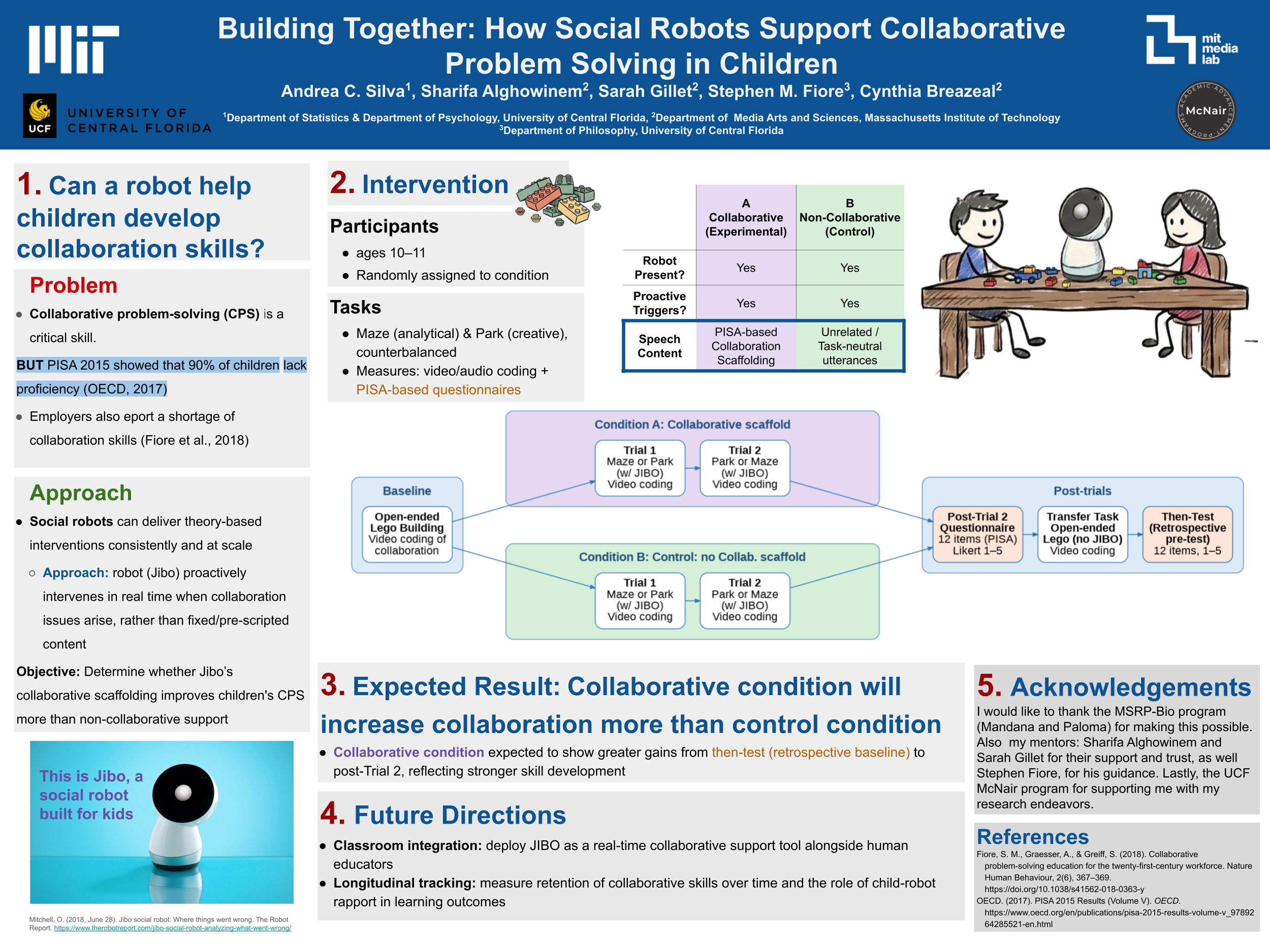
Andrea C. Silva, Sharifa Alghowinem, Sarah Gillet, Stephen M. Fiore, Cynthia Breazeal. Building Together: How Social Robots Support Collaborative Problem Solving in Children (August 2026) Poster presented at annual MIT Summer Research Program Showcase, Cambridge, MA
